5. Test A Variant
Page: Variant · Goal: take one site across the whole cohort. Who carries it, does AlphaGenome predict that it changes expression, and does GTEx, which measured expression in real people, agree?
Open Variant → from the Sequence page, or type a variant on the Variant page: an rsID, a
position, chr15:28120472 A>G or a GTEx ID (chr15_28120472_A_G_b38). With no variant, the page
lists the window's common sites.
Who carries it
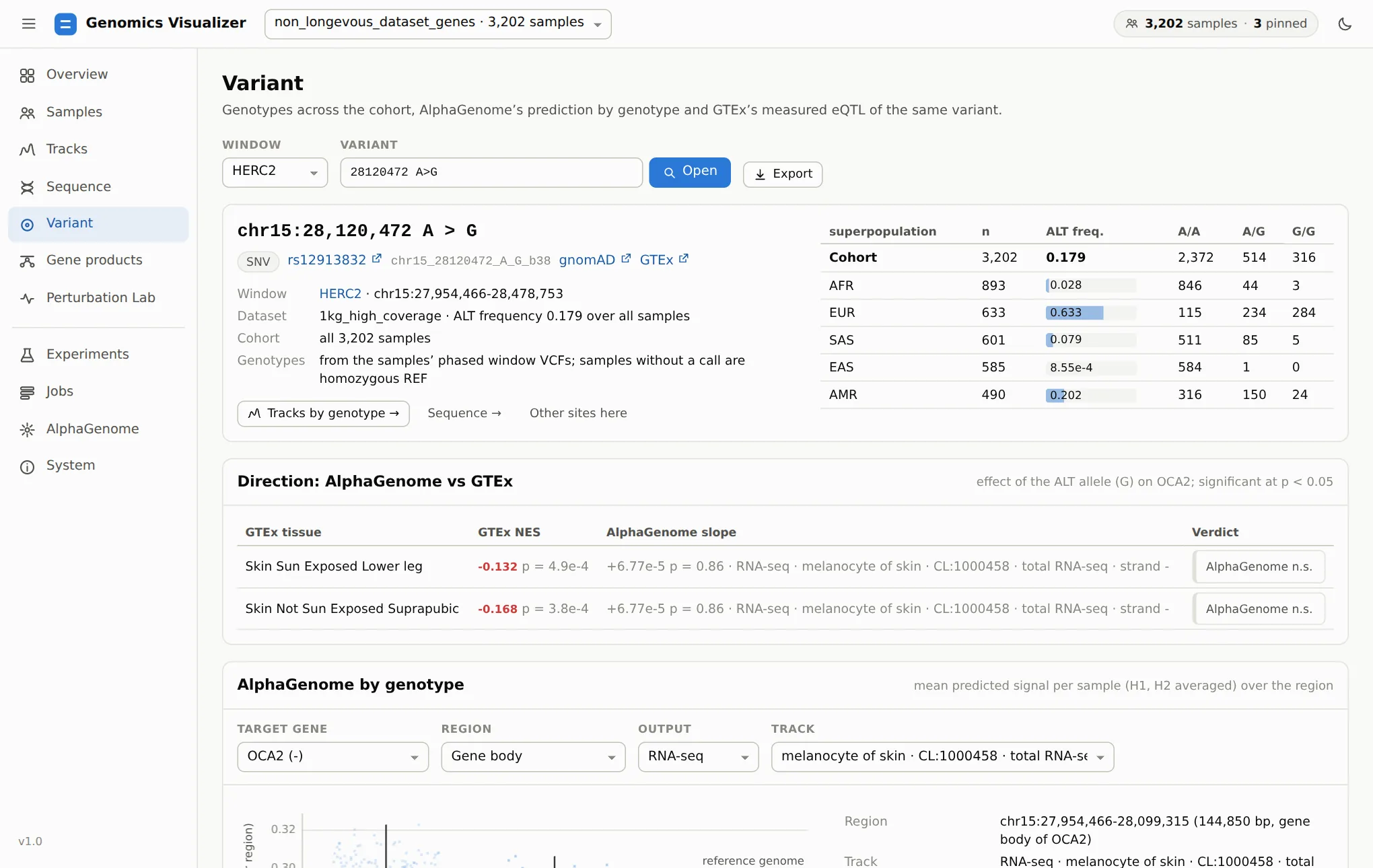
The header links the variant to dbSNP, gnomAD and GTEx, and counts genotypes in the cohort and by any field (superpopulation by default). Genotypes come from each sample's phased window VCF, read once per window in parallel and cached (a few seconds for 3,202 samples).
Tracks by genotype → opens the Tracks page with group means split by the genotype at this site. It is the visual version of the next card.
Does AlphaGenome predict an effect?
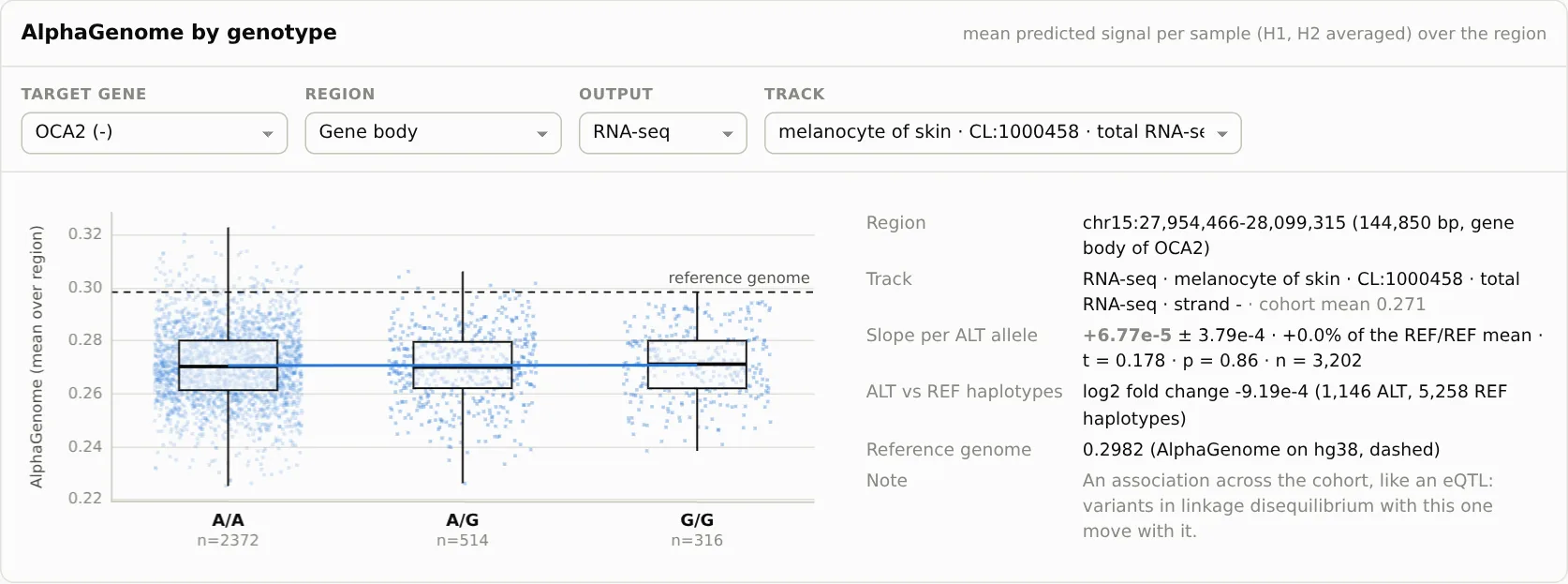
This is an in-silico eQTL: every genome's prediction, grouped by genotype, with an ordinary least-squares slope per ALT allele. Choose the target gene, the region (gene body, promoter TSS ± 1 kb, the variant ± 1 kb, or custom), the output and the track. By default the track is the one with the highest signal on the target gene's strand.
Here the slope is +6.8 × 10⁻⁵ per G allele (p = 0.86): no predicted effect.
What this slope is, and is not
It is an association across the cohort, like an eQTL from people. It therefore includes the effect of every variant in linkage disequilibrium with this one. Every genome is predicted in full, so variants elsewhere in the window contribute too. It is not the effect of changing this single base. That is what the Perturbation Lab tests. Also note the OCA2 gene body here starts at the window edge, so the region covers only the part of OCA2 inside the HERC2 window.
Does GTEx agree?
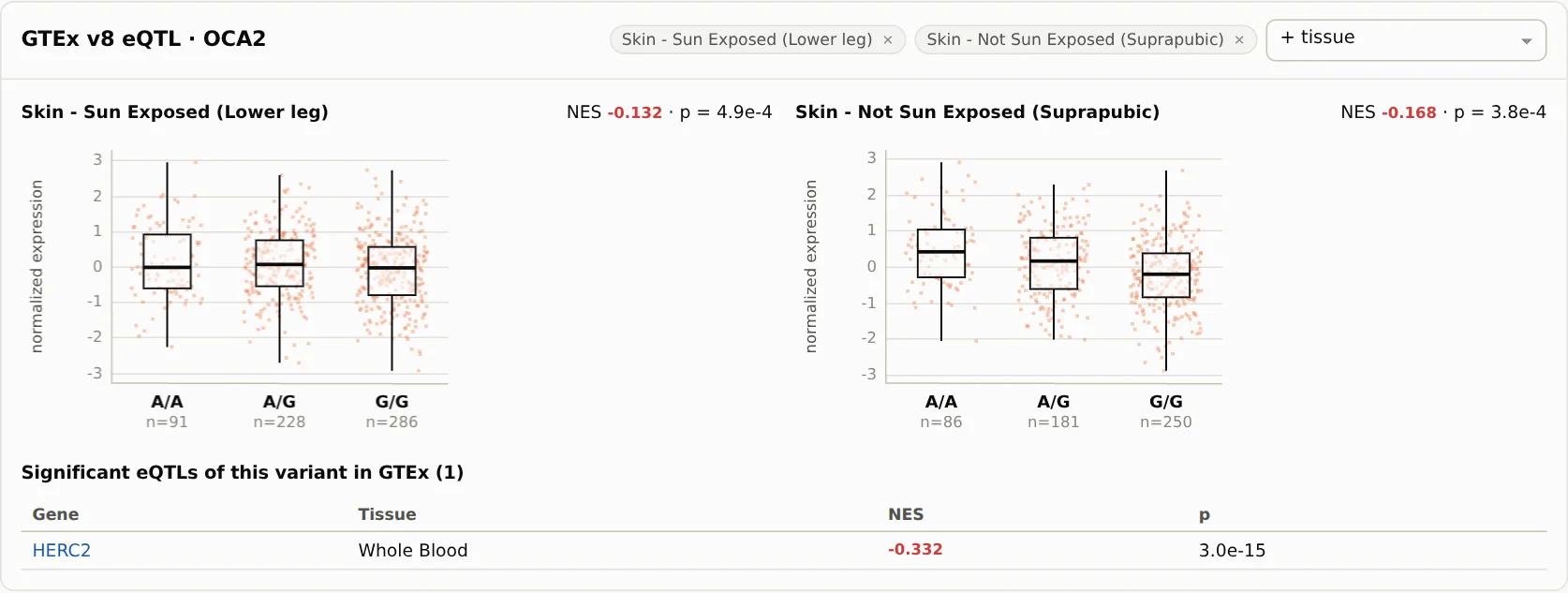
GTEx measured expression in donors' tissues. For rs12913832, OCA2 is lower with the G allele in both skin tissues (NES −0.13 and −0.17, p < 10⁻³). The page puts the two side by side:

So the measured eQTL exists, but the model does not reproduce it: AlphaGenome n.s. There are possible reasons, none of them tested here. GTEx has no melanocytes, and bulk skin is mostly other cells. The enhancer is reported to act through a chromatin loop to the OCA2 promoter, in melanocytes. The page does not explain the disagreement. It makes sure you see it before you build on the prediction. Compare signs, not magnitudes: GTEx's NES is in normalized-expression units, and AlphaGenome's slope is in its own track units.
GTEx answers come from the GTEx portal API (v8, GRCh38) and are cached. --no-remote uses cached
answers only.