6. From DNA To Protein
Page: Gene products · Goal: follow one individual's two copies of a gene into the mRNA and protein each copy makes in a tissue, and say how sure each statement is.
Choose a window, a sample, a gene and a tissue. The tissue picker lists all 285 ontology terms AlphaGenome has RNA-seq for. We look at HG00096 in melanocyte of skin (CL:1000458), first at MC1R, the red-hair gene, then at TYR.
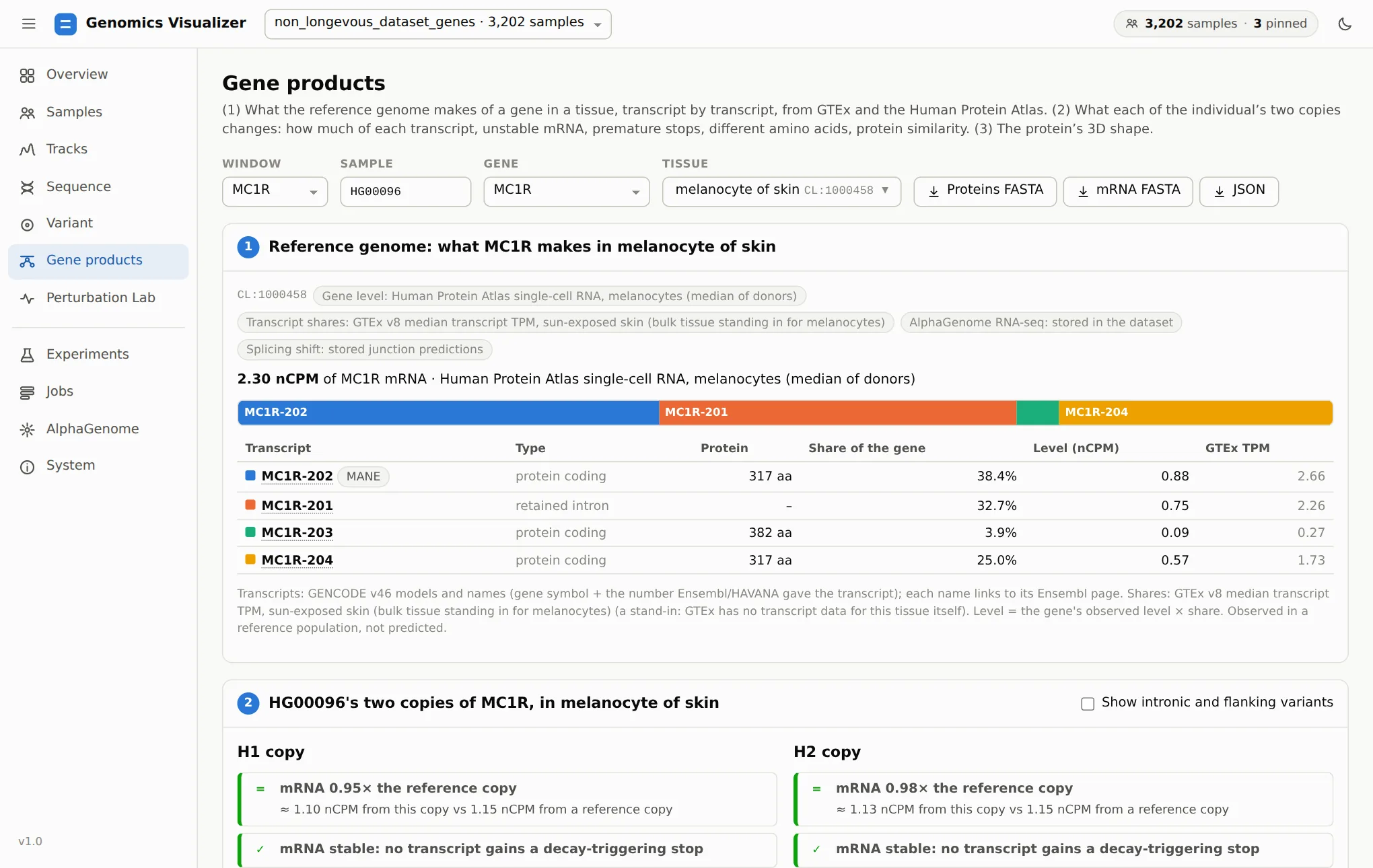
The chips under each heading say where every number comes from: observed (Human Protein Atlas, GTEx), predicted (AlphaGenome RNA-seq and splice junctions, stored or predicted on demand), or computed (translation, NMD rules).
1. Reference genome: what the gene makes
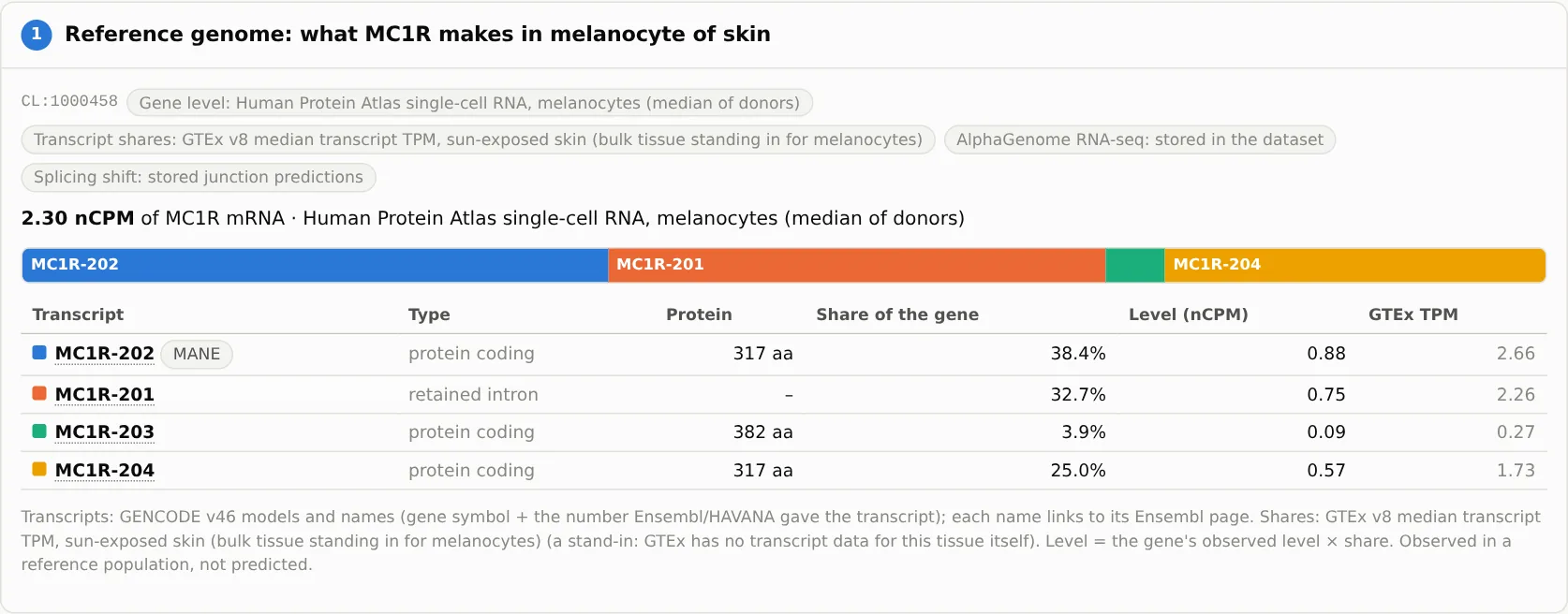
This step is observed, not predicted. The gene's level comes from a reference population, and GTEx's transcript TPMs split it over the transcripts. GTEx has no melanocytes, so sun-exposed skin stands in, and the page says so. MC1R-202, the MANE Select transcript, makes 38% of the mRNA. A retained-intron transcript makes another third.
2. The individual's two copies
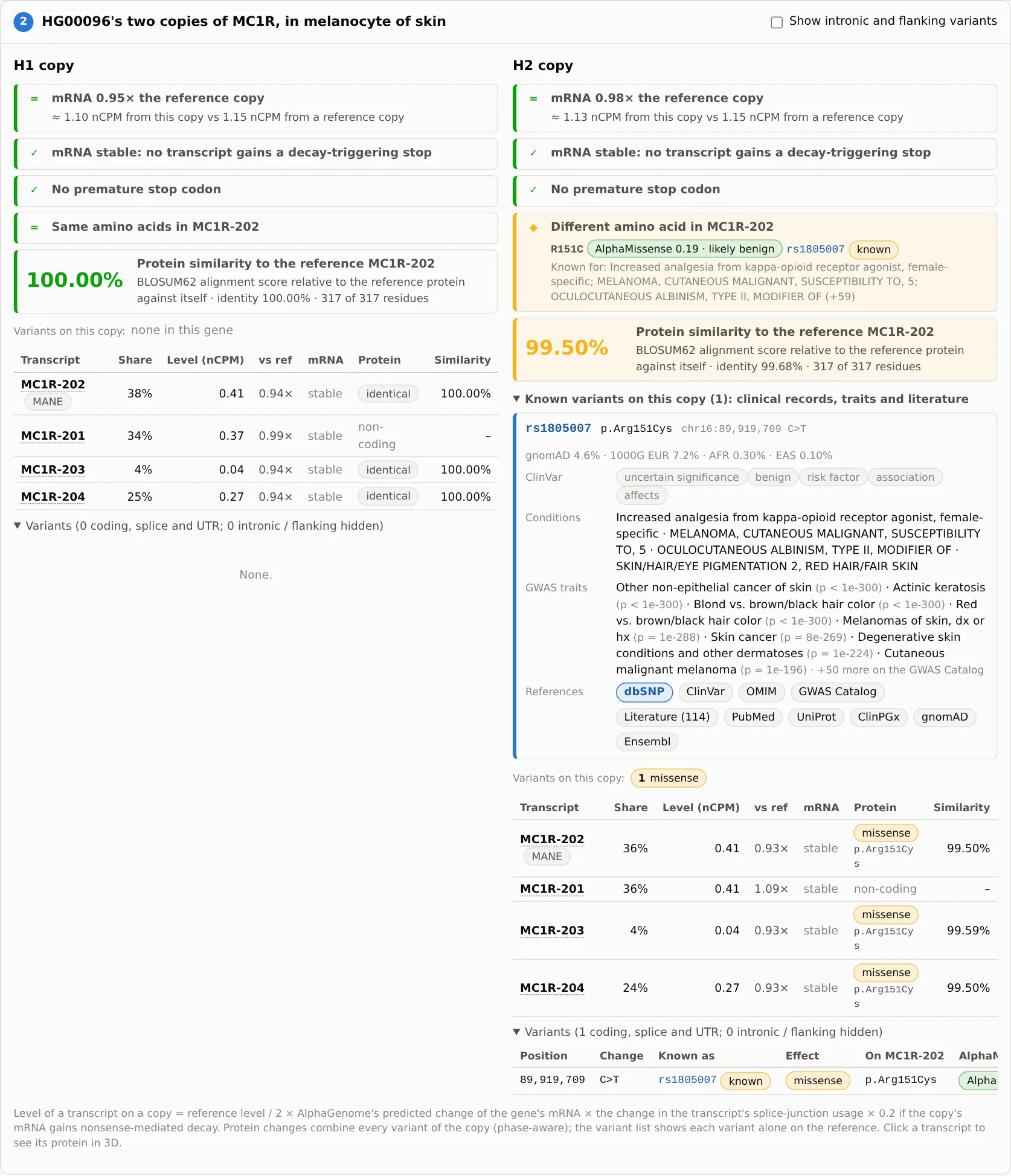
Each copy gets the same checklist of verdicts:
| Verdict | How it is decided |
|---|---|
| mRNA level vs a reference copy | AlphaGenome RNA-seq of this haplotype vs the reference window, over the gene's exons (a fold), times the observed level for an absolute estimate |
| mRNA stable | No transcript gains a stop codon that triggers nonsense-mediated decay (50-nt rule, with the usual escapes) |
| No premature stop | No transcript's protein ends early (nonsense, frameshift) |
| Same / different amino acids | The copy's spliced, translated protein vs the reference. All of the copy's variants act together (phase-aware). Each missense change carries its AlphaMissense score |
| Protein similarity | BLOSUM62 global alignment score relative to the reference protein against itself (1 = identical) |
Variants the page lists are looked up in Ensembl VEP, which sends only positions and alleles. Known variants get a panel with ClinVar significance and conditions, GWAS Catalog traits, gnomAD and 1000 Genomes frequencies, and links to dbSNP, ClinVar, OMIM, LitVar, PubMed, UniProt, ClinPGx and gnomAD. For rs1805007, ClinVar lists red hair / fair skin, melanoma susceptibility and a female-specific increased analgesia from κ-opioid agonists. AlphaMissense still rates R151C as likely benign (0.19). The page shows the population genetics and the structure-based score side by side and does not reconcile them.
Now switch the gene to TYR:
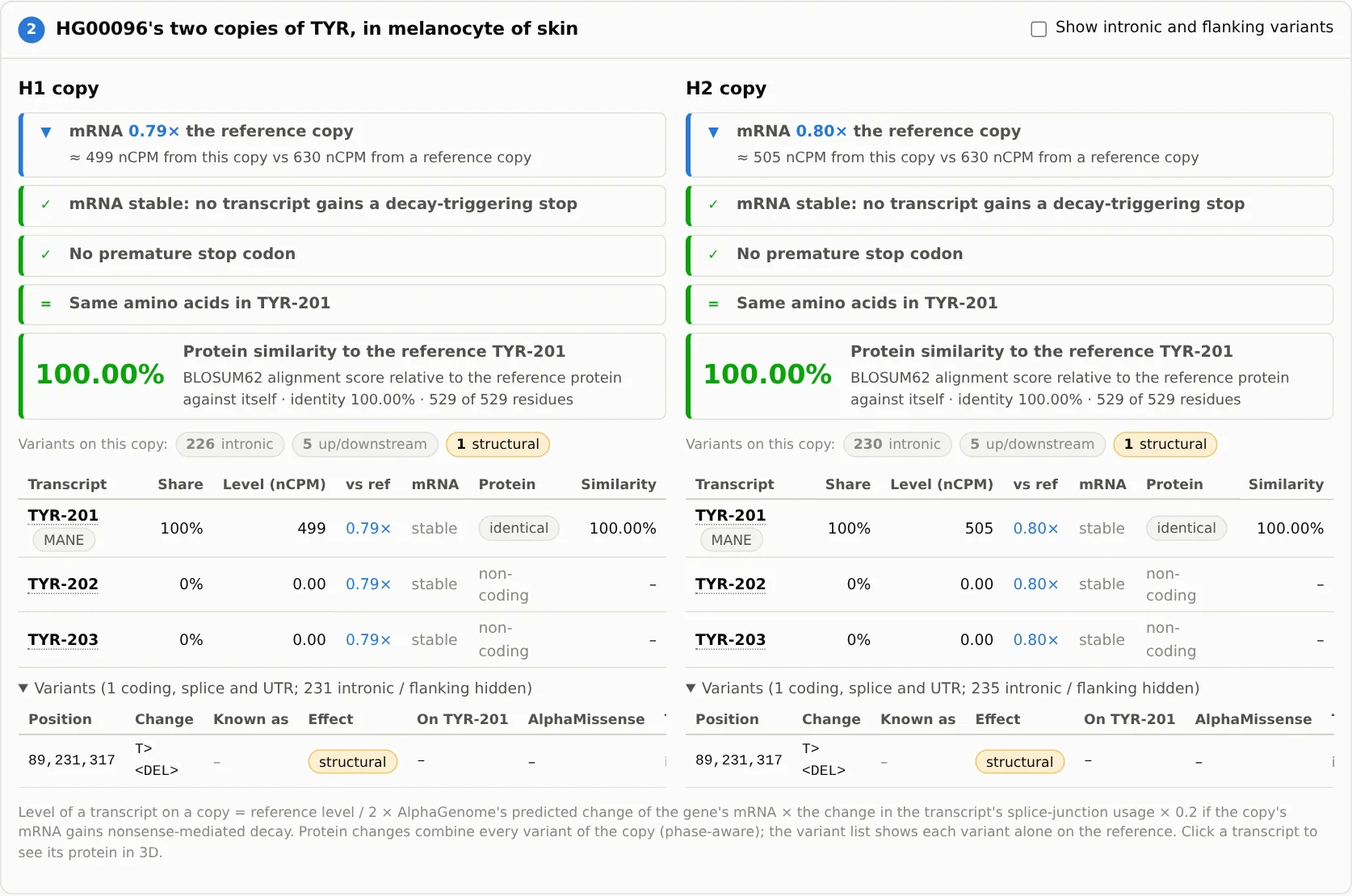
Here the protein is identical on both copies, but AlphaGenome predicts less mRNA: 0.79× and 0.80×.
That is about 500 instead of 630 nCPM per copy, anchored on HPA melanocytes. Both copies carry an
intronic structural deletion (<DEL> at chr11:89,231,317). You will see it as a gap in the tracks
in step 8.
3. Protein shape
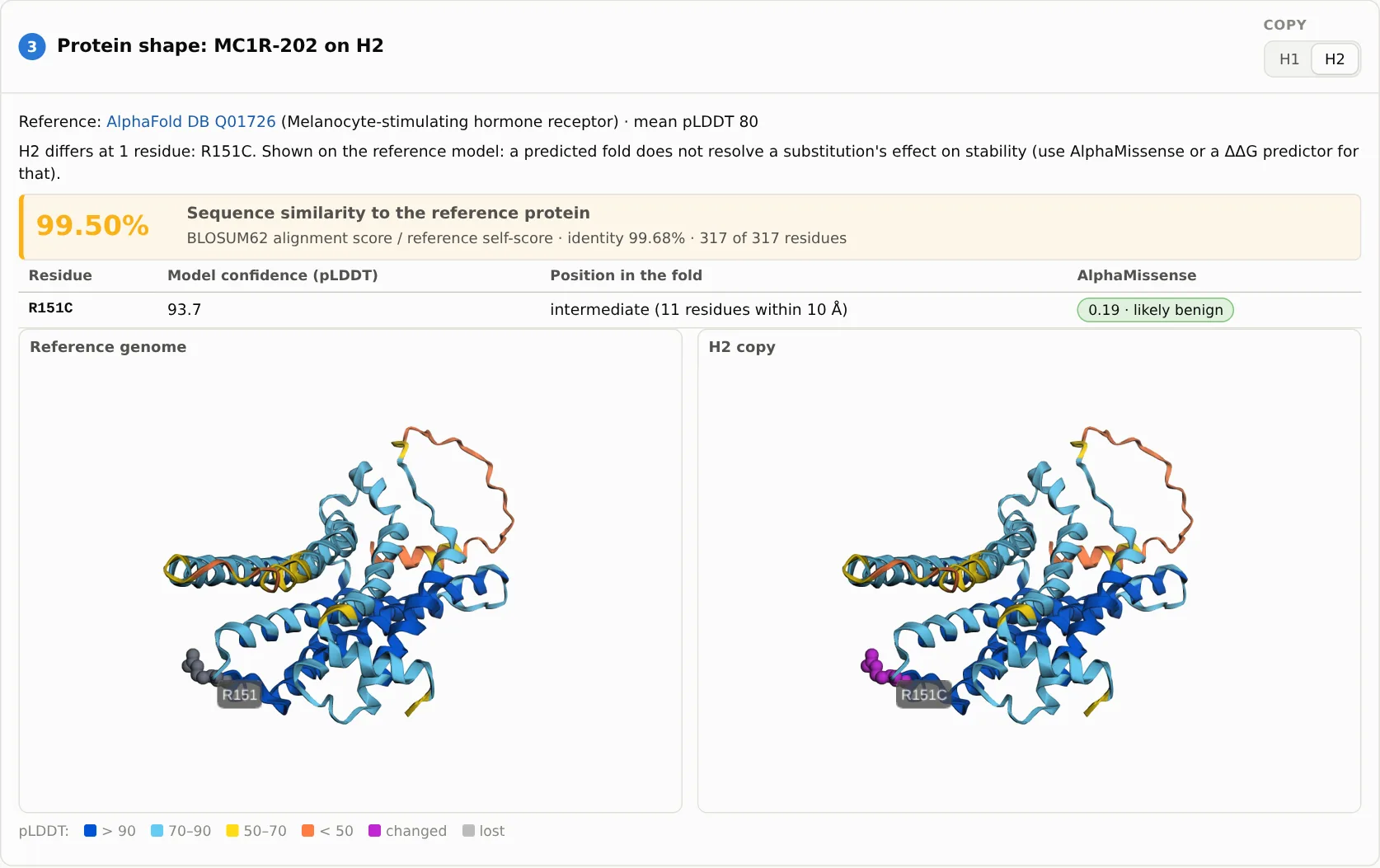
For the selected transcript and copy, the page loads the reference protein's AlphaFold DB model
(found through UniProt's Ensembl cross-reference) and marks each substitution. It reports the
residue's model confidence (pLDDT 93.7 here) and how buried it is (11 neighbours within 10 Å). A
predicted fold does not show what a point mutation does to stability, and the page says so.
Products that change after some residue (frameshifts, in-frame indels, other isoforms) can be folded
with ESMFold, on request only, because the sequence is sent to api.esmatlas.com. The result
includes a TM-score against the reference. More evidence also has the mRNA's secondary structure
around the start codon, stop codon or a variant (ViennaRNA), with ΔΔG.
More evidence
Everything else sits under More evidence.
How much? compares mRNA and protein against the reference genome in several tissues, and keeps relative (what the model is trusted with) apart from absolute (relative × an observed anchor):
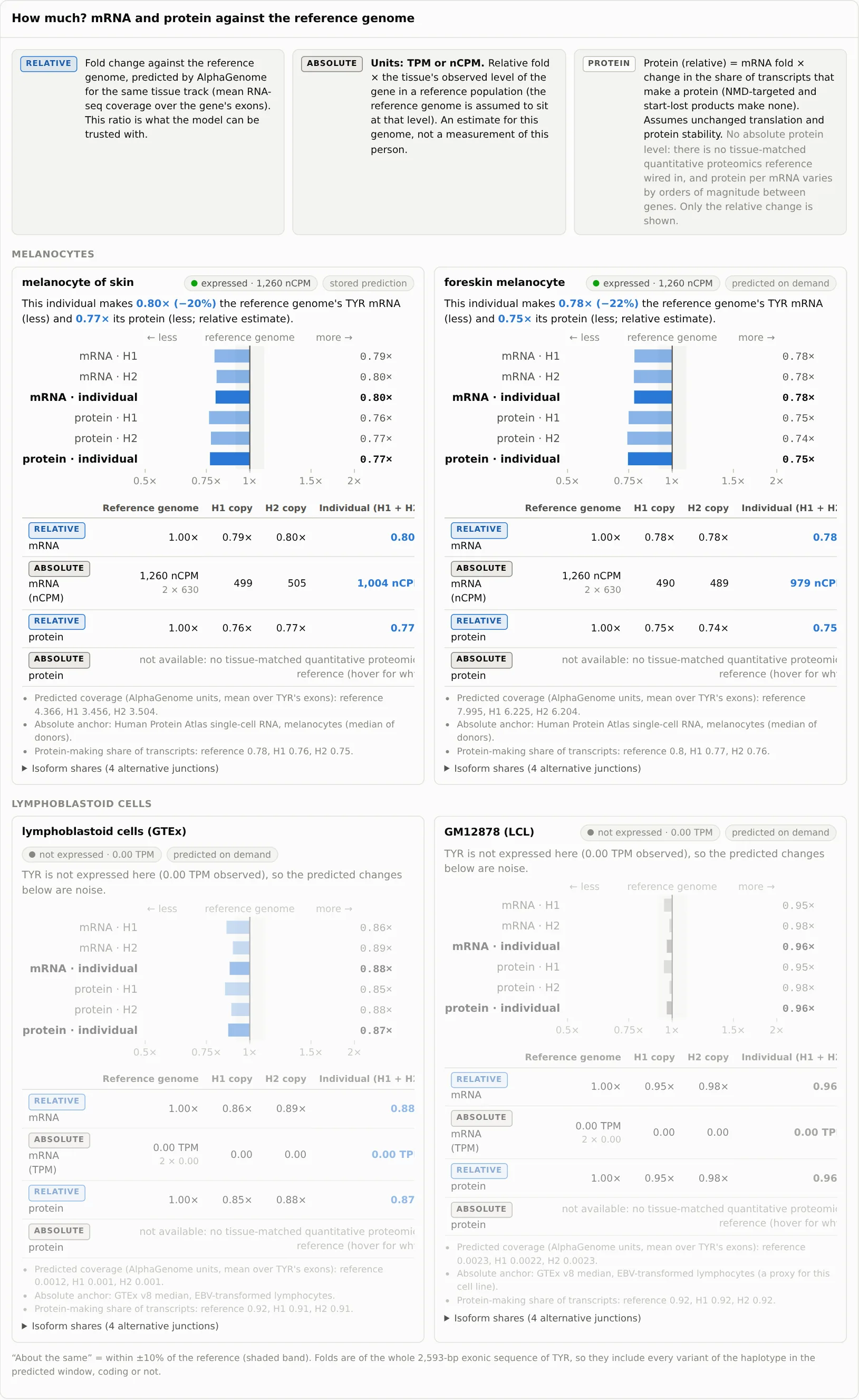
There is no absolute protein level: no tissue-matched quantitative proteomics reference is wired in, and protein per mRNA varies by orders of magnitude between genes.
Splicing uses AlphaGenome's predicted splice junctions per haplotype:
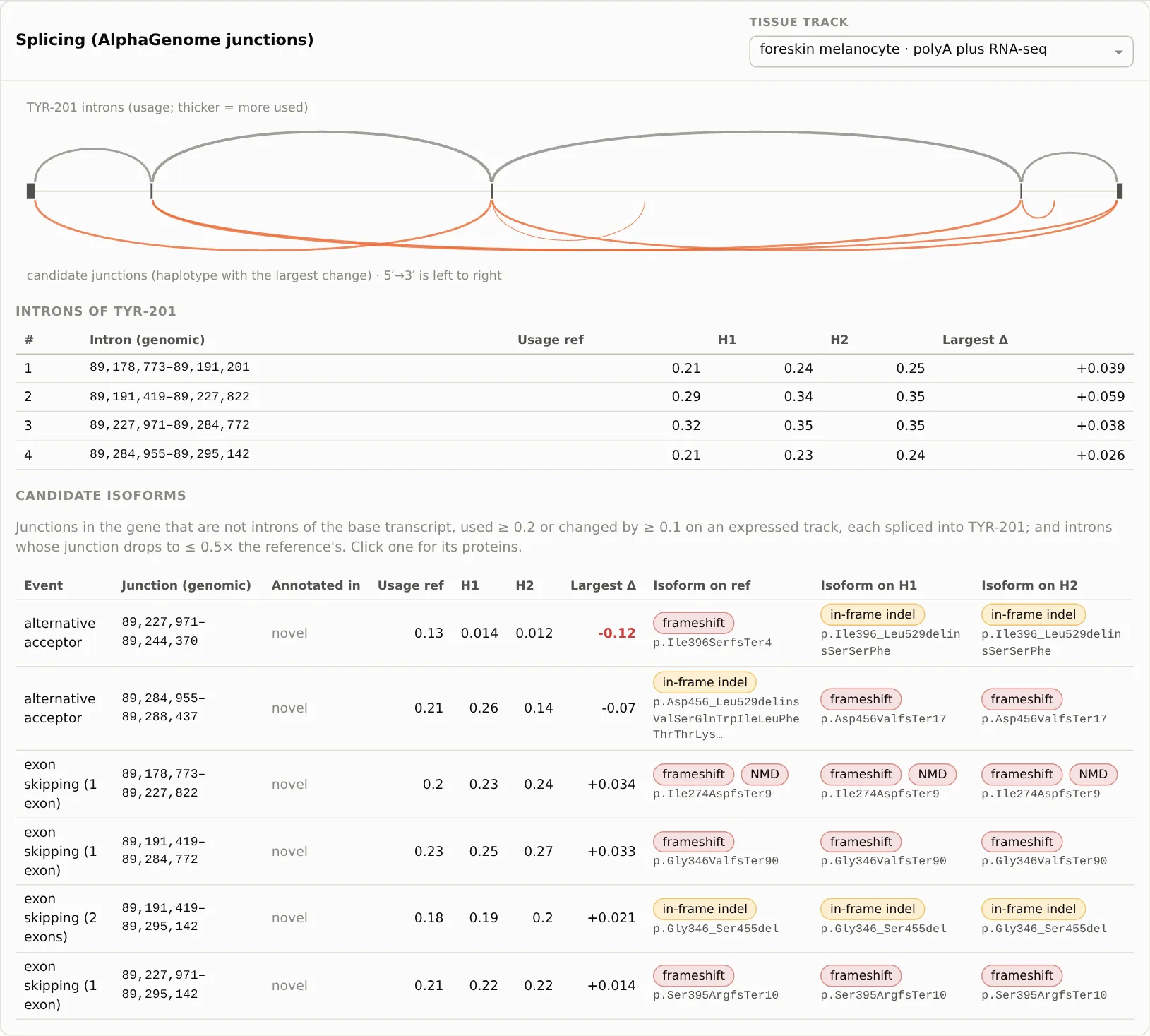
Candidate isoforms are hypotheses from a sequence model, not measured transcripts. Usage values are relative, not abundances. They are worth checking against RNA-seq of the individual, e.g. Geuvadis for 1000 Genomes LCLs.
Export
Proteins FASTA, mRNA FASTA and JSON download every product (annotated transcripts and candidates, per haplotype) for pathway, structure or variant-effect tools.
Checked against independent tools
On HG00096 (44 windows, GENCODE v46), all 166 complete reference proteins are identical to
Ensembl 112's peptides. All 454 transcript × haplotype consequences agree with bcftools csq -p a
run on the same VCFs (scripts/diagnostics/validate_gene_products.py).