7. Train And Evaluate Models
Page: Experiments · Goal: train a model that reads predicted tracks, read its results, and find out what it actually learned.
Needs the [genotype] extra (PyTorch): scripts/env/install.sh --training.
The runs table
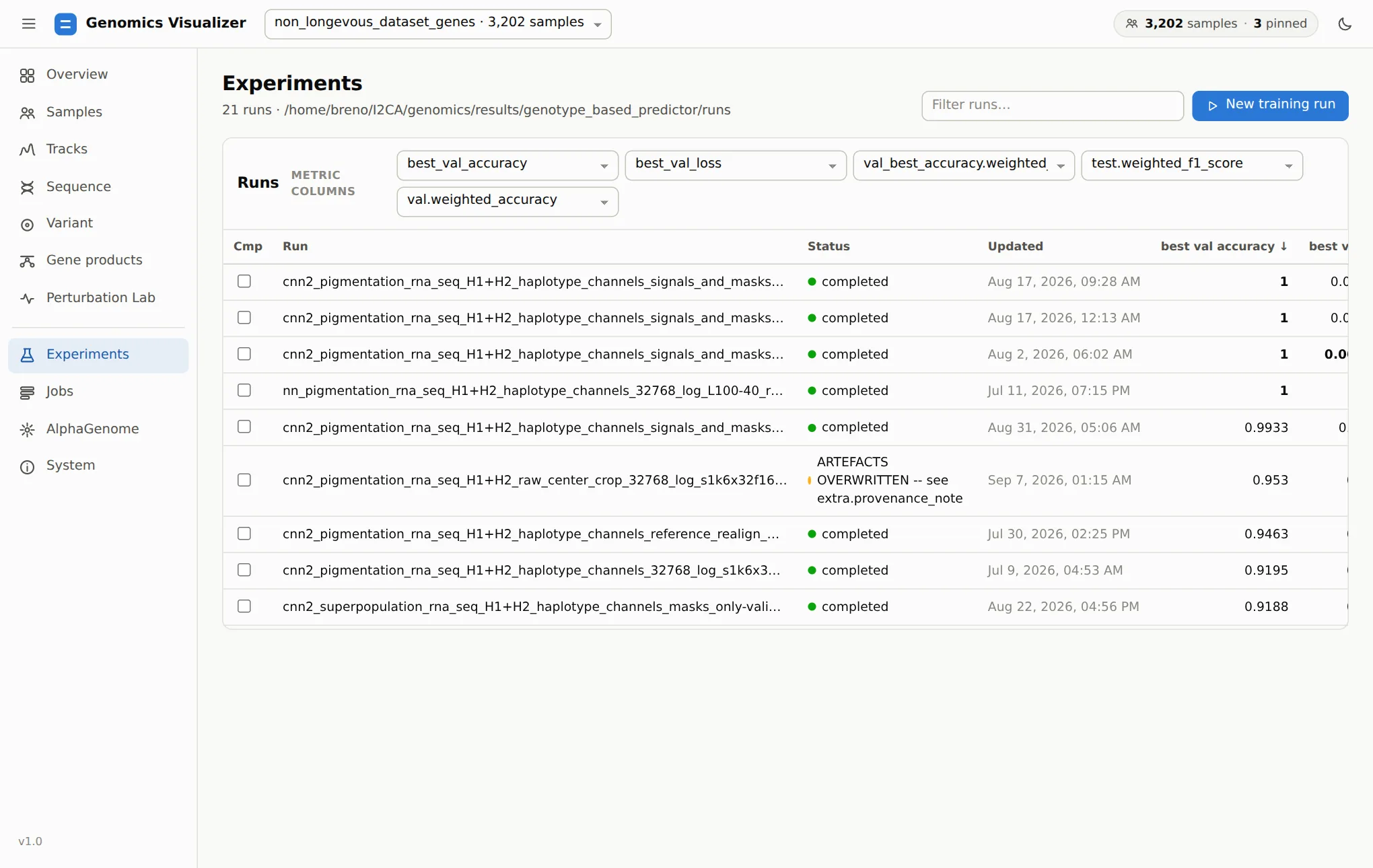
weighted_* included, and every column sorts.Look at the top of the table. Several pigmentation CNNs reach a validation accuracy of 1. That is too good for a trait as complex as pigmentation, and step 2 explains why. In this cohort, weak and strong pigmentation are European and African genomes, and those can be told apart from almost any stretch of DNA. Before reading such a number as biology, compare it with a run that cannot have learned biology. That is what the negative controls below are for.
Tick Cmp on several runs to overlay their training curves.
A run
Click a run to open it:
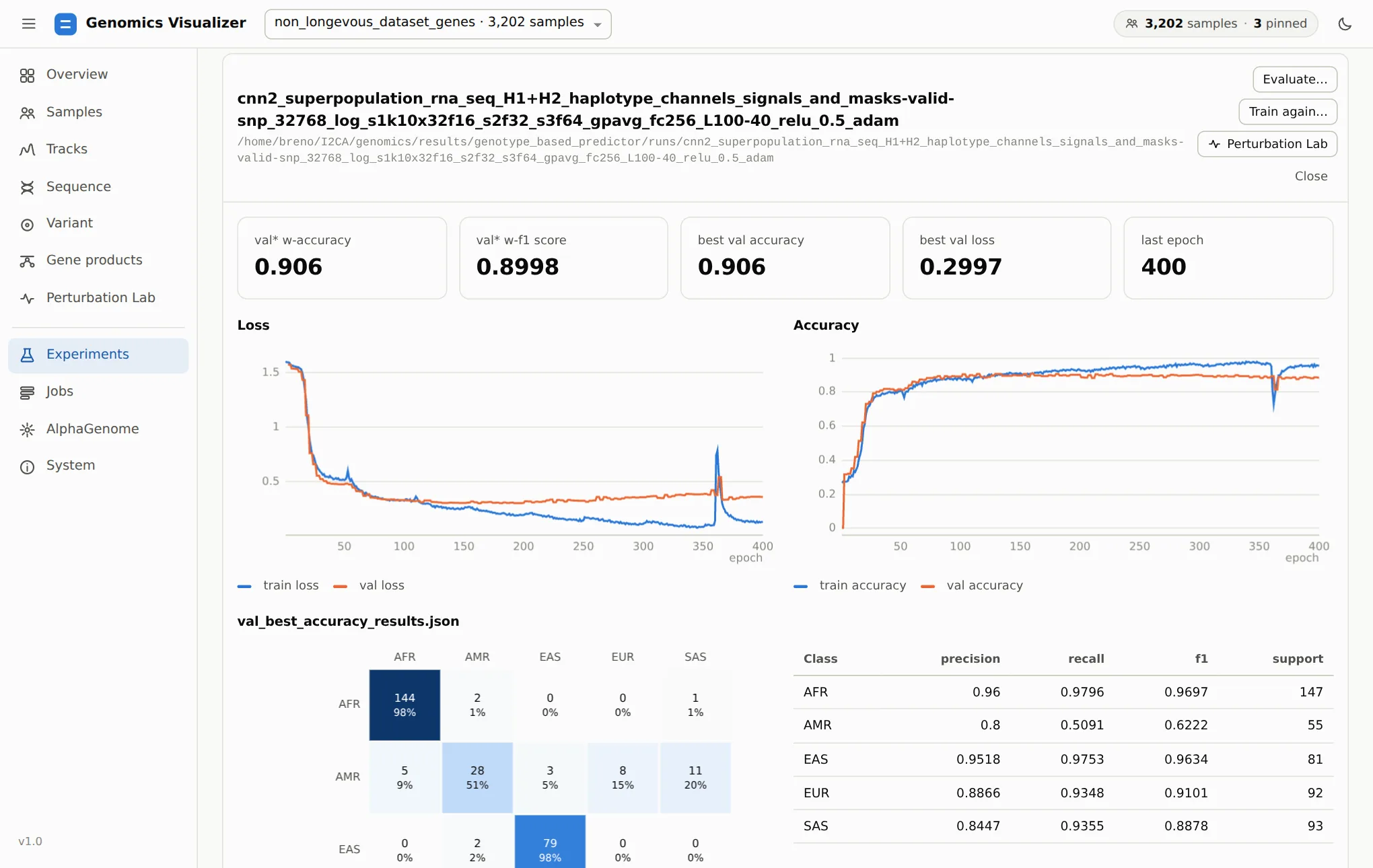
The run page shows the summary metrics, train and validation loss and accuracy curves, the confusion matrix and per-class precision, recall and F1 for each results file, the config and the plots the run saved. Three buttons act on it:
- Evaluate… evaluates any checkpoint on any split, as a background job
(
<split>_<checkpoint>_results.json). - Train again… opens the training form prefilled with this run's settings.
- Perturbation Lab opens the run in step 8.
Start a training run
New training run (or Train a model on the Overview or Jobs page) opens the training form:
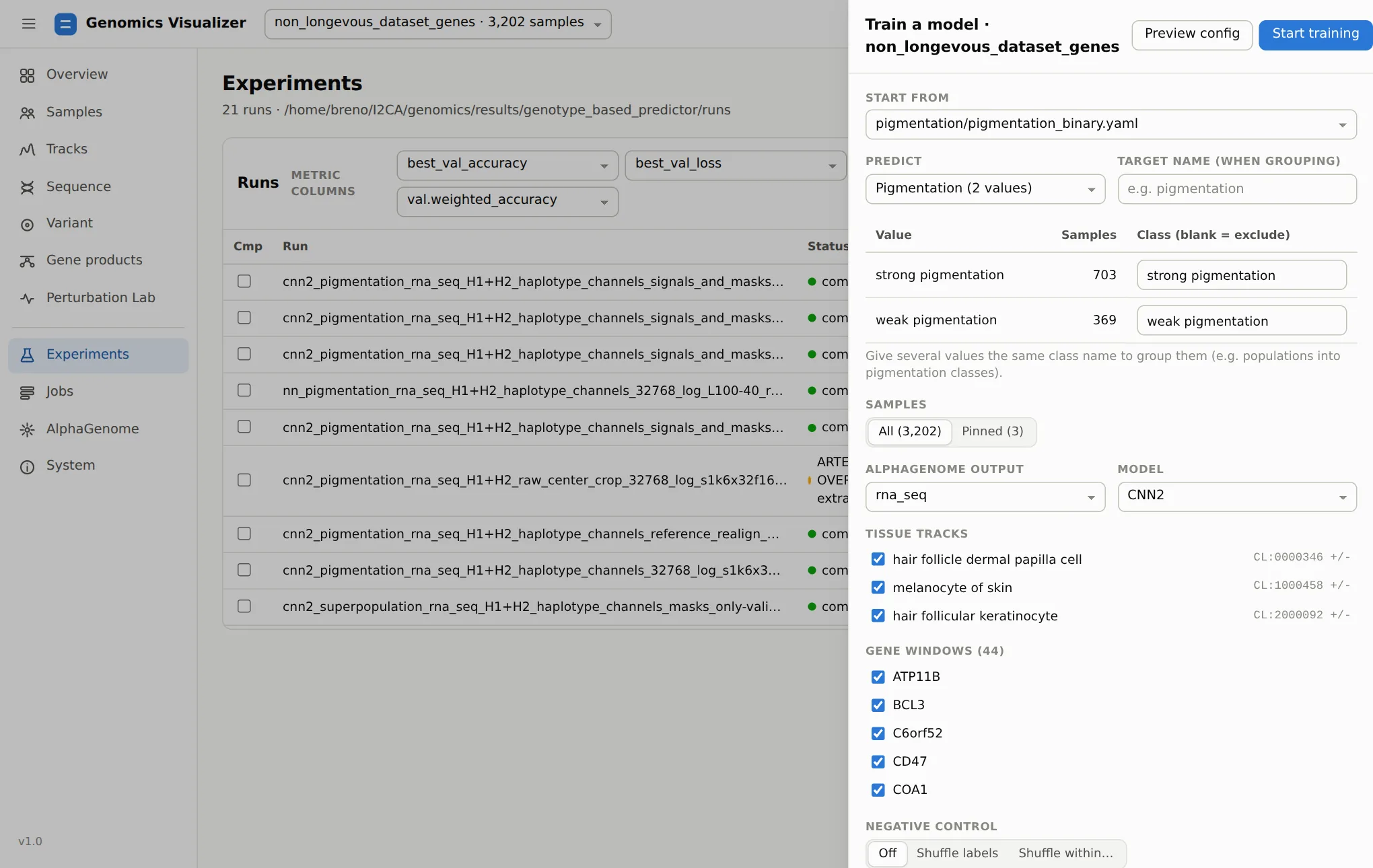
pigmentation_binary.yaml.- Start from a config under
configs/predictors/genotype_based/or from an existing run. - Predict any categorical sample field. Each value maps to a class, and values can be grouped (e.g. populations into pigmentation classes) or excluded.
- Samples: all, or only the pinned ones (for a quick smoke run).
- AlphaGenome output, model (NN, CNN, CNN2), tissue tracks and gene windows.
- The window around each gene, the features, epochs, batch size, learning rate, seed and split fractions.
Preview config shows the YAML the run will use. Start training queues it on the gpu queue.
The run appears on this page with live curves, and the best checkpoint is evaluated on the test
split when training ends.
Negative controls
A classifier's accuracy only means something next to what the same pipeline scores when the signal it is supposed to use is gone. The form builds two kinds of control into the same run:
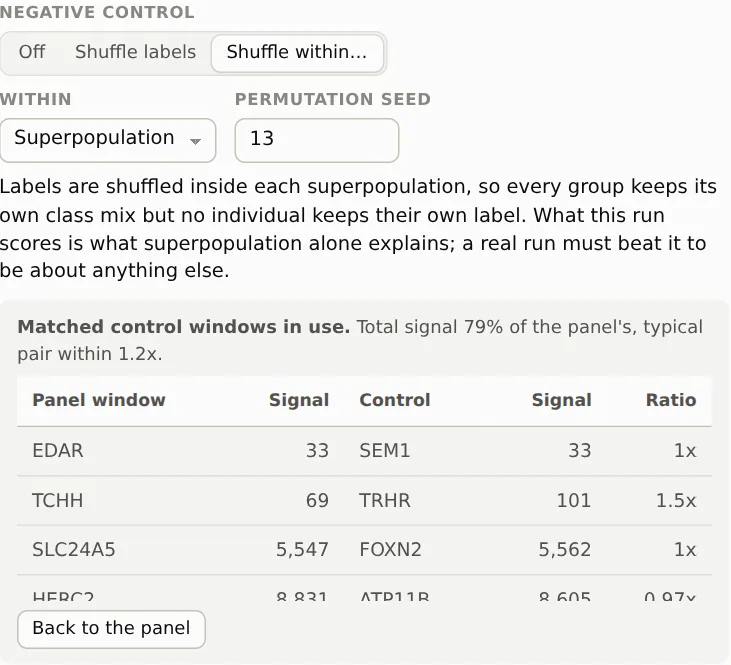
Shuffled labels. Shuffle labels permutes labels over all samples. Class sizes stay the same,
but nothing links a genome to its class, so this run is the pipeline's chance floor. Anything above
it means a leak (through the split, the normalization or a cache). Shuffle within… permutes
inside each group of a field. With superpopulation, every population keeps its own class mix, but
no individual keeps their own label. What that run scores is what ancestry alone explains, and a
real pigmentation result has to beat it. Runs are tagged _yrand / _yrand_within_<field>.
Matched control windows. Matched control windows… replaces the gene panel with an equal number of windows outside the dataset's gene list. It does not pick them at random: each control is matched to a panel window on the total predicted signal inside the crop the model reads, on the reference genome. A quiet control window would be flat for reasons unrelated to biology and would prove nothing. The match needs no AlphaGenome calls, only the stored reference predictions, and the form shows every pair before you start. Here the 11 pigmentation windows pair with SEM1, TRHR, FOXN2, ATP11B, … for a control panel carrying 79% of the panel's total signal (typical pair within 1.2×).
A reading order for any result
- Real labels, real panel: the number you hope is interesting.
- Shuffled labels: the floor. If (1) is not far above it, stop.
- Shuffled within superpopulation: what ancestry explains. (1) must beat it.
- Matched control windows, real labels: what any comparably expressed genes give. (1) must beat that too before it is about these genes.
Configs, schemas and the CLI equivalents (genomics genotype train | evaluate | test) are in
Genotype predictor and
Training and running predictions.